

Introduction
A Buchner funnel is a flat-bottomed funnel used with filter paper and a vacuum to separate a solid from a liquid quickly. It is the everyday tool for vacuum filtration, pulling the liquid through far faster than gravity alone and leaving a firm, well-drained solid behind.
You will find it in chemistry, pharmaceutical, materials and research labs across Australia, most often for collecting the crystals from a recrystallisation, isolating a precipitate, or washing and drying a solid product. Paired with a filter flask and a vacuum source, it turns filtration from a slow wait into a quick, repeatable step.
This guide covers what a Buchner funnel is, what it is used for, how vacuum filtration actually works, how to set one up step by step, and how to choose the right funnel for your bench.
What is a Buchner funnel?
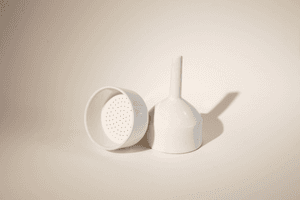
A Buchner funnel is a funnel with a flat, perforated plate near its base. A disc of filter paper sits on that plate, the solid-and-liquid mixture goes in on top, and a vacuum applied underneath draws the liquid through while the solid stays on the paper as a cake.
On its own the funnel is only part of the setup. It seats into a thick-walled filter flask through an airtight adapter, and the flask connects to a vacuum source. Tap a part below to see how the pieces fit together. It is named after the industrial chemist Ernst Buchner.
Tap a part to learn what it does.
What a Buchner funnel is used for
The common thread is fast separation of a solid from a liquid under vacuum. Typical laboratory uses include:
- Collecting crystals after a recrystallisation
- Isolating a precipitate from a reaction
- Washing a solid product on the filter
- Drawing air through to dry the filter cake
- Filtering larger volumes quickly
- Recovering a catalyst or drying agent from a solution
Because the vacuum both speeds the flow and helps pull the cake dry, the Buchner funnel is the usual choice whenever you care about the solid, rather than simply clarifying a liquid.
How vacuum filtration works
Vacuum filtration works on a pressure difference. The vacuum lowers the pressure below the filter paper, so ordinary atmospheric pressure above the mixture pushes the liquid through the paper much faster than gravity could. Step through the setup and see it run.
STEP 1 OF 6
How to set up a Buchner funnel
The animation above walks through it visually. As a checklist to follow at the bench:
- Secure the filter flask. Clamp a thick-walled, vacuum-rated side-arm flask to a stand. A standard conical flask is not built for vacuum and can implode.
- Seat the funnel. Fit the Buchner funnel into the flask neck with a snug rubber adapter, bung or ring, so the join is airtight.
- Add and wet the paper. Lay a filter paper disc that covers every hole without curling up the sides, then dampen it with a little solvent so the mixture cannot slip around the edge.
- Connect the vacuum through a trap. Run tubing from the side arm to a trap bottle, then to a water aspirator or vacuum pump, so nothing can be drawn back into your filtrate.
- Apply vacuum and pour. Switch on the vacuum, then pour the mixture steadily into the centre of the funnel. The liquid is pulled through and the solid builds up as a cake.
- Wash, dry, then release. Rinse the cake with a little cold solvent, keep the vacuum on to pull it dry, then break the vacuum at the source before switching off to avoid suck-back.
Materials and types
Buchner funnels come in a few materials, each with a sweet spot. Tap one to see where it fits.
BEST FOR
For very small quantities, a Hirsch funnel is the close relative to reach for: it works the same way but is smaller, with sloped sides suited to collecting milligram amounts of solid.
Find the right funnel
Answer three quick questions and we will suggest a funnel and material, with a link to shop it on LabFriend.
1. How much solid are you collecting?
2. What is the sample chemistry?
3. Filter paper or a reusable frit?
Pick an option above to see a suggestion.
Common mistakes to avoid
A few habits cause most filtration headaches. Watch out for:
- Using a thin-walled flask not rated for vacuum, which risks implosion
- Not wetting the paper first, so the mixture seeps around the edges
- A paper disc that is too large and curls up the sides, leaving a leak path
- No trap in the line, so water or oil is sucked back into the filtrate
- Switching off the pump before breaking the vacuum, causing suck-back
- Pouring too fast and overflowing the funnel
Each of these costs you either product or a clean result, so they are worth building into your routine.
Vacuum vs gravity filtration
The Buchner funnel is for vacuum filtration, but gravity filtration still has its place. Compare the two below.
Frequently asked questions
What is a Buchner funnel used for?
For vacuum filtration: quickly separating a solid from a liquid. It is most often used to collect crystals after recrystallisation, isolate a precipitate, and wash and dry a solid product on the filter.
How does vacuum filtration work?
A vacuum lowers the pressure below the filter paper. Atmospheric pressure above then pushes the liquid through much faster than gravity, and continued suction helps pull the filter cake dry.
What flask do I use with a Buchner funnel?
A thick-walled, vacuum-rated filter flask, also called a side-arm or Buchner flask. The funnel seats in the neck through an airtight adapter, and the side arm connects to the vacuum. A standard conical flask is not safe under vacuum.
Do I need filter paper?
Porcelain, glass and plastic Buchner funnels use a flat disc of filter paper on the plate. A sintered, or fritted, glass funnel has a built-in porous plate, so it filters without paper and can be cleaned and reused.
What is the difference between a Buchner and a Hirsch funnel?
They work the same way. A Buchner funnel has straight sides and a larger flat plate for grams of solid or more; a Hirsch funnel is smaller with sloped sides, made for collecting milligram quantities.
Why do I wet the filter paper first?
A little solvent seals the paper flat against the plate. That stops the mixture from creeping under the edge and lets the solid build an even cake rather than slipping through.
How do I avoid suck-back into my sample?
Fit a trap bottle between the flask and the vacuum source, and always break the vacuum at the source, or disconnect the tubing, before switching the pump off. That way liquid cannot be drawn back into your filtrate.
Final thoughts
The Buchner funnel is a simple piece of kit that makes filtration quick, clean and repeatable. Understanding how the vacuum does the work helps you set it up safely, choose the right funnel and material, and finish with a cleaner, drier solid. For any lab that isolates solids, it stays a bench essential.
Ready to filter faster?
Browse Buchner funnels, filter flasks and filtration gear at LabFriend.


